
Eyed Daylilies – a guide to the Bette Davis stars of the Hemerocallis World
If you want to add the wow factor to your border or patio it’s hard to look beyond these exotic-looking flamboyant characters which invariably cause comment and wonder.
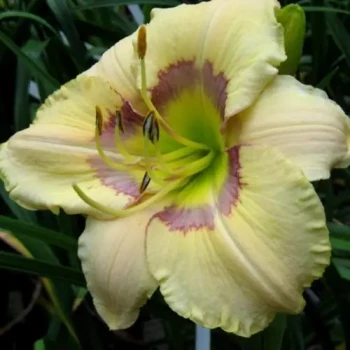
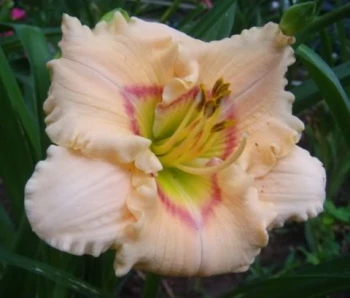
Described as an ‘eyezone’ it is a coloured area that surrounds the throat of the flower. It varies considerably in size, shape and colouring with many different combinations. The throat itself is invariably green or yellow-green and serves as a tranquil pool captured by the bolder colouring of the eyezone. Newer varieties can feature an eye that covers over half of the flower face and it can be difficult to decide if, for example, it’s a pink petal with a red eyezone if it is a red flower with pink tips or a pink flower with red! An an added feature of eyed Daylilies is that some varieties have a matching petal edge in the same colour as the eye.
This inner circle of colour can be as narrow as a pencil line as in the famous ‘Maleny Debutante’, a band of colour, or wider and almost circular. In colour it can be self-coloured or graduated with multi-colours as in ‘Enchanted Rainbow’ These graduated multi-hued eyes sometimes need a spell of warmer weather ti develop properly but in most cases the solid eyezones are pretty consoistent no matter what the weather.
It is possible to have eyed Daylilies with eyezones of red, purple, near black, bluish, wine or near-blue. Sometimes they are solidly coloured but they can also feature what’s called a watermark eye where the colours appear as if ink on blotting paper!
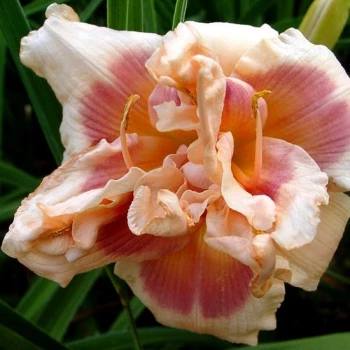
The eyezone feature features on varieties within all classes whether it be the large flowered, miniature, spiders and also the doubles. Forty Second Street is a good example of an eyed double.
The eyed classes offer something different again in Daylilies and have the magic to capture the imagination of all gardeners. They have often been accused of fostering the Hemerocallis addiction that has overcome many a plant lover as their exotic looking beauty doesn’t come at a price, the plant itself as reliable and easy-going as any Daylily.
So here is my rundown of the most notable eyed Daylilies. No doubt you have your own favourites – let me know!
15 flamboyant eyed Daylilies for your garden
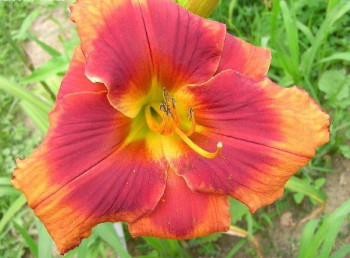
Frank Smith
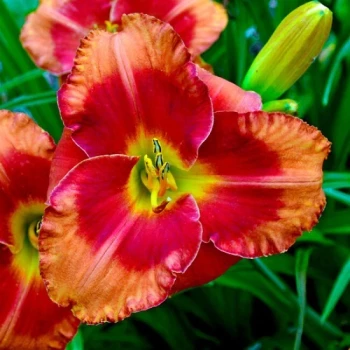
A vivid tomato red covers half of the bloom face on this flame coloured beauty. It was raised by Kirchhoff in 1997 and blooms early in the season. Flower stems are typically around 24” tall. Tetraploid.
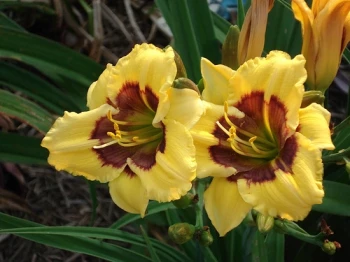
Jason Salter
Although a small flowered variety Jason Salter boasts a lot of character and is also a superlative performer with a very long repeat blooming season. The flowers are corn-gold with a washed raisin-plum eye. Stems are about 18” tall and it was raised by Salter in 1987. Perfect in pots or smaller spaces in the border.
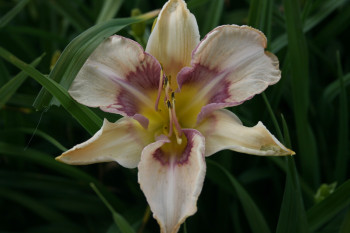
Gerda Brooker
I regard this as the unicorn of the Daylily world as it carries with it a lot of mystique and is very hard to find. The layered water-0mark stained lavender and blue-toned eye is entrancing and set on creamy apricot coloured petals. Fragrant, beguiling. Raised by Morss in 1995 the flowers appear on 30” stems fairly early in the season.
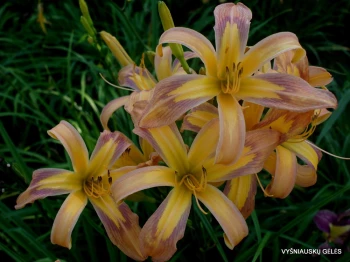
Discarded Beauty
The feathered lavender eye sits way out towards the petal extremities on this very large flower which blooms with considerable freedom. It is a spider type Daylily with dangly narrow petals. So named because the seedling was found growing on a compost heap and once the raiser witnessed it’s blooms rescued it and it was named and introduced. So from humble beginnings a true beauty became celebrated. It’s flowers are typically 9” across on 28” stems and it was introduced by Messrs Trimmer in 2009.
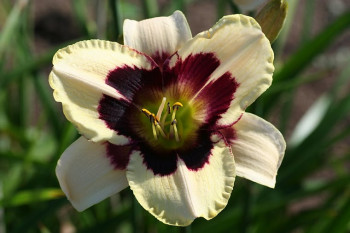
Moonlit Masquerade
I have made no secret that I regard this as one of the finest Daylilies ever rasised with it’s boldly patterned blooms, great habit and re-blooming tendencies. The near black eye is boldly presented on a white ground, and there is a partial matching edge too. The flowers are 5.5” across and it was raised in 1992 by Salter. Stems around 20” tall here.
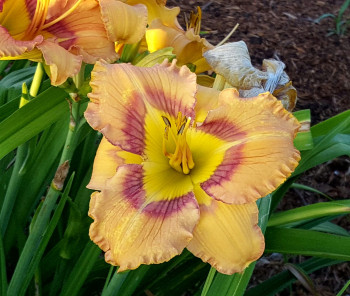
Web of Intrigue
Often one of the earliest of the large flowered hybrids to open, the base colour varies between creamy apricot to light orange on which is set the fascinating graduated blue-purple and violet eyezone which has been likened to ink staining blotting paper. As this many of the very complex eyezones this develops best during warmer spells but it is a heavy bloom with up to 35 buds per scape! Complicated but top notch parentage resulted in this renowned award winner. Stamile year of introduction 1999, blooms Are 6” across and borne on 30” stems. The season is very early.
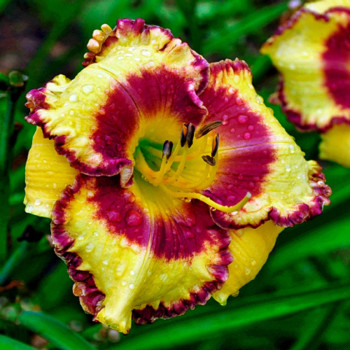
Steve Trimmer
Has pizzazz, really good form and snazzily patterned bright blooms. The fantastic bordered edge matches the eyezone to great effect. It was raised by trimmer in 1999, the flowers are around 5.5” across although they are appear even larger due to the fulsome form. Stems 28” high and it blooms through the early-mid season period on very well branched scapes.
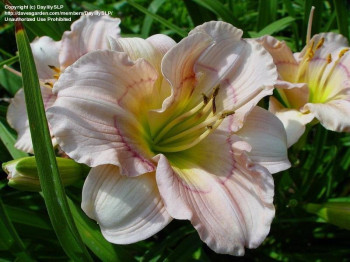
Baby Blues
A cutie you’ve simply no excuse not to include and it is adorable; the stems are only 16” tall so it is very compact and ideal for all smaller spaces. The apricot tinted cream flowers feature a pencil line blue eye of great artistry. It blooms through the mid season and the flowers are 3” across.
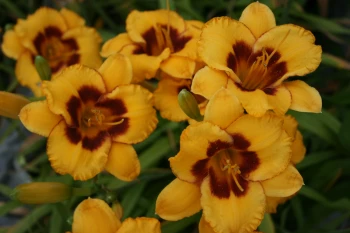
Now and Zen
Consistently one of the most freely flowering varieties here and the blooms are diamond dusted. Featuring rich glowing gold colour each with a dominating red eye this one sure packs a punch! It flowers on 25” stems, has great branching and is open throughout the mid season period. Raised by Hansen in 1999.
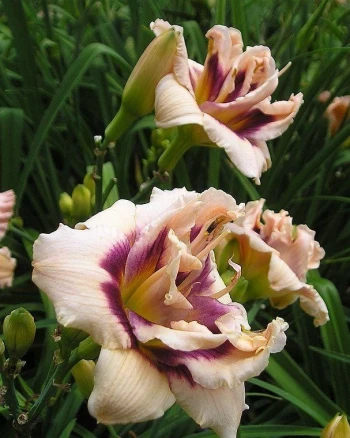
Roswitha
A very boldly eyed double of 3.5” across opening on short 14” stems. The deep purple eye contrasts nicely with lighter coloured petals. Great for container work, it’s season is early to mid., Trimmer 1992.
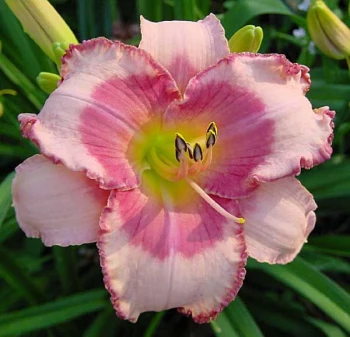
Strawberry Fields Forever
Often considered the archetypal eyed Daylily the top notch parentage has resulted in a classic modern variety. Shell pink to rose with a luscious big strawberry coloured eye and matching edge; blooms for a long time too. Raised by Stamile in 1997, stems are around 26” tall and it blooms early to mid season. A good grower.
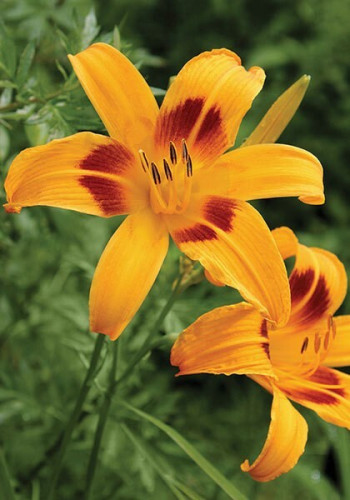
Mikado
I wanted to include at least one bygone variety and it had to be Mikado. No longer nearly as common as it once was, the graceful flowers have a notched burgundy eye on brilliant gold background. Taller stems and narrow foliage lend a graceful feel to the border and increases quickly. Considered a breakthrough in breeding at the time, this was introduced way back in 1929 by Stout. Stems are taller than average at around 36”.
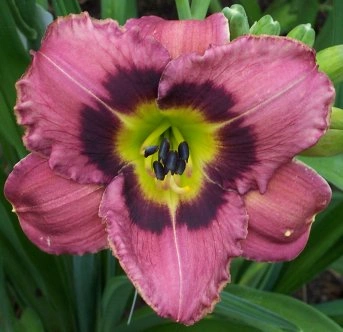
Always Liberty
Light purple with a dark purple banded eye and partial edge. A stunner and an improved version of the popular ‘Always Afternoon’ it’s generously sized flowers measure 6” across. Blooming early-mid season on strong 23” stems. Opens well in all weathers.
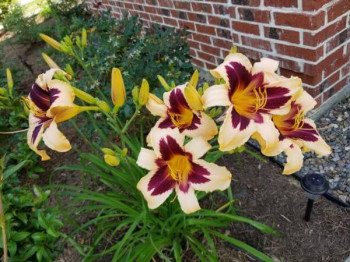
Wild Horses
Very like the aforementioned ‘Moonlit Masquerade’ but narrower with a bold purple eye. It is tall at 37” so shows very well in the centre of an Island bed and blooms freely with sizeable 7” blooms. Season early, raised by Trimmer and introduced in 1999.
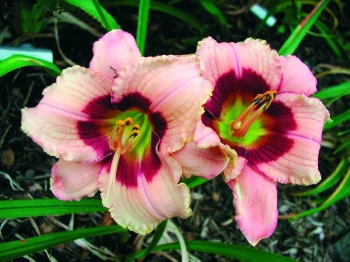
Orchid Candy
I wanted to include this one because aside from the lovely eyezone it also has the added attraction of a noticeable fragrance. It is one of the Stamile’s famed ‘Candy’ series which always do so well.
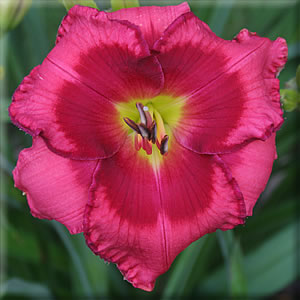
Dan Mahony
We’ll finish with one of the most dashing of all as Don Mahony features one of the most vivid and colour-popping central flower colours of all, that and the rich rose pink deeply enhanced petal colour gives each bloom a real lustre. The blooms present very well with a formal outline and gently recurved petals. Introduced by Trimmer in 1992, scapes are approximately 26” tall and begin opening early season carrying on through mid season as well.
OK so that’s sixteen but I couldn’t help but get carried away!
Thanks for reading.
John.